

The Cotton King
Knowing land and owning it were two different things.
Choose Your Edition
The Cotton King
Paperback
eBook
Genre
Historical Fiction · Black Fiction
Setting
Willowridge, North Carolina · 1942R. L. Alexander's ALTVERSE
Availability
Available Now
Format
Paperback · eBook
Edition
Second Edition · 2026
Publisher
Asterrow Books
Length
314 pages
Beyond The Page
A novel can only stop for so much.
The Cotton King follows Judd King through the part of his life that changes everything, but the people and places surrounding him had to exist beyond whatever reached the page. The Kings needed a history before Judd. Willowridge needed streets people had been walking long before the story opened. Farms needed boundaries, families needed memories, businesses needed customers, and the year 1942 had to keep moving whether a particular piece of history entered a chapter or not.
A great deal of that work remains behind the novel. Some of it helped me understand who these people were. Some of it helped me understand where they were standing. Some answered questions I needed settled without requiring Judd to stop and explain them to the reader. Other pieces simply became things I loved enough to want them somewhere.
That is what this part of the site is for. Here you can spend more time with the King family, walk through Willowridge as a place rather than a setting, look closer at the ideas of land and inheritance running beneath the story, and see some of the research, maps, decisions, and revisions that went into building the novel.
None of it is required to understand The Cotton King. It is here for anyone who finishes a page and wants to look a little farther down the row.
A STEP CLOSER TO THE FAMILY AT THE CENTER OF THE COTTON KING
The King family has been in Willowridge longer than Judd King has been alive, and their history reaches farther back than Willowridge itself. What survives from one generation to another is not written neatly in a book. It lives in remembered stories, farming habits, names, warnings, arguments, and the things older people insist the young ought not forget.
In 1896, Titus King came to Willowridge from Durham with his wife, Perlie, and their four children. He arrived looking for work and found it on land belonging to Harrison Jakes. Titus proved to be an exceptional farmer, and what began as one man needing employment became a relationship between two families that would continue through three generations. Harrison gave way to George Jakes and then Ethan. Titus gave way to Haywerd King and then Judd. The Jakeses inherited the land. The Kings inherited the knowledge of how to make it grow.
By 1942, that history rests most heavily on twenty-five-year-old Judner “Judd” King. Judd is a husband, father, farmer, sharecropper, and skeptic with little patience for explanations that cannot survive daylight. He has spent his life hearing that the Kings possess something extraordinary, but he knows exactly how much labor goes into a healthy field. He knows soil, weather, insects, seed, water, timing, and the thousand small judgments that separate farming from merely putting something in the ground and hoping. When people call the King touch a gift, Judd has a simpler word for it.
Farming.
That certainty is part of what makes Judd a King. So is the stubbornness.
Beside him is Mattie King, his wife and the person least impressed by Judd’s attempts to carry everything alone. Mattie understands the household with the same precision Judd brings to a field. She knows what is in the cupboard, what can wait until next week, when one of the children is getting sick, and when her husband has walked through the door pretending something is fine when it plainly is not. She does not treat the old King stories as unquestionable truth, but neither does she dismiss generations of family memory simply because Judd finds it easier to believe in dirt than miracles. Their marriage is built from affection, work, teasing, disagreement, exhaustion, and the familiarity of two people who genuinely know one another.
Their children, five-year-old J.J. and three-year-old Coretta, make the King inheritance something more than a story about the past. J.J. already wants to follow his father into the fields and believes being one day older ought to qualify him for considerably more responsibility than anybody else thinks wise. Coretta is younger, expressive, affectionate, and entirely capable of entering an adult conversation without the slightest concern for whether she was invited. They are children first. But every old story Judd begins to reconsider raises another question he cannot keep confined to himself: whatever the Kings carry, what happens when it reaches the next generation?
And then there is Alma Brooks King, Judd’s mother, who remembers the people Judd can only remember through stories. Alma knew Titus and Perlie. She heard the family history from men and women who did not consider it folklore because, to them, it was simply what happened. She does not speak like an oracle and does not pretend to know what she does not know. She can forget a date, correct herself halfway through a story, or argue over which relative said what. Yet there is one thing she has never been willing to laugh away.
The Kings have always been different around growing things.
Judd believes generations of knowledge explain that difference.
Alma knows her son well enough to let the land argue with him.
THE PLACE THAT MADE THE STORY POSSIBLE
Willowridge is fictional. The world pressing against it is not.
In 1942, Willowridge, North Carolina, is a small Southern town shaped by agriculture, railroad traffic, family history, Black enterprise, white authority, wartime shortages, and Jim Crow. People know one another here. They recognize automobiles and surnames. They know who belongs to which church, who has been seen talking to whom, whose family has been farming a particular stretch of ground for forty years, and which places in town welcome everybody only until somebody tests what welcome actually means.
For Judd King, Willowridge is home. That matters because home in The Cotton King can be complicated.
East Willowridge is the center of Black community life, with homes, churches, businesses, a school, medical care, recreation, barbershops, families, children, gossip, work, music, arguments, and people who have built a life for themselves despite the limits imposed around them. Across the river lies Townsquare, Willowridge’s civic and commercial heart, where Black and white residents may occupy the same streets without possessing the same rights once they enter the buildings. Farther west, the town becomes more firmly white. South of the developed streets, Willowridge opens into its agricultural country: barns, farmhouses, dirt lanes, pasture, cotton, corn, wheat, work animals, ponds, woodlots, and the long farm roads leading toward the Jakes property.
A person can cross Willowridge much faster than the social distance between its communities would suggest, and that contradiction runs beneath the novel. Judd can drive through Townsquare on his way to work, know the merchants, recognize the buildings, and understand every turn in the road while also knowing which businesses want his money without particularly wanting him. He can be one of the finest farmers in the county and still work ground another man owns. Ethan Jakes can love Judd like a brother and still possess legal and economic freedoms Judd does not. A decent person living inside an unjust system does not make the system disappear. The novel never asks Willowridge to pretend otherwise.
The year brings its own pressures. The United States is at war. Men have entered military service or left farms for better-paying defense work. Rubber is difficult to replace. Gasoline on the East Coast is rationed. Machinery and parts are becoming harder to obtain. Farmers are being asked to produce more while the hands, vehicles, supplies, and materials needed to do that work grow scarcer. Judd’s aging Studebaker matters because a tire is no longer something he can casually replace. A trip into town costs fuel. A missing farmhand leaves work that still has to be done.
And then there is the cotton. Boll weevils had already spent decades teaching Southern farmers what a small insect could do to an economy built around a crop. The outbreak threatening Willowridge in the novel is fictional, but the conditions behind it are historically grounded: humid weather, pest pressure, rising treatment costs, wartime labor shortages, and farmers watching the expected value of their fields disappear square by square.
Against that backdrop, one patch of cotton begins behaving differently.
The difference is quiet at first. A healthier plant. A square that remains attached. Damage where damage ought to be everywhere except here. A farmer notices. Then another.
And Willowridge, being Willowridge, begins to talk.
Maps & Places
HOW WILLOWRIDGE FOUND ITS PLACE


Not literally. There was never going to be a forgotten North Carolina town waiting for me with a sign at the city limits. What I needed was a piece of real geography capable of supporting the fictional place I had already imagined.
Story Map
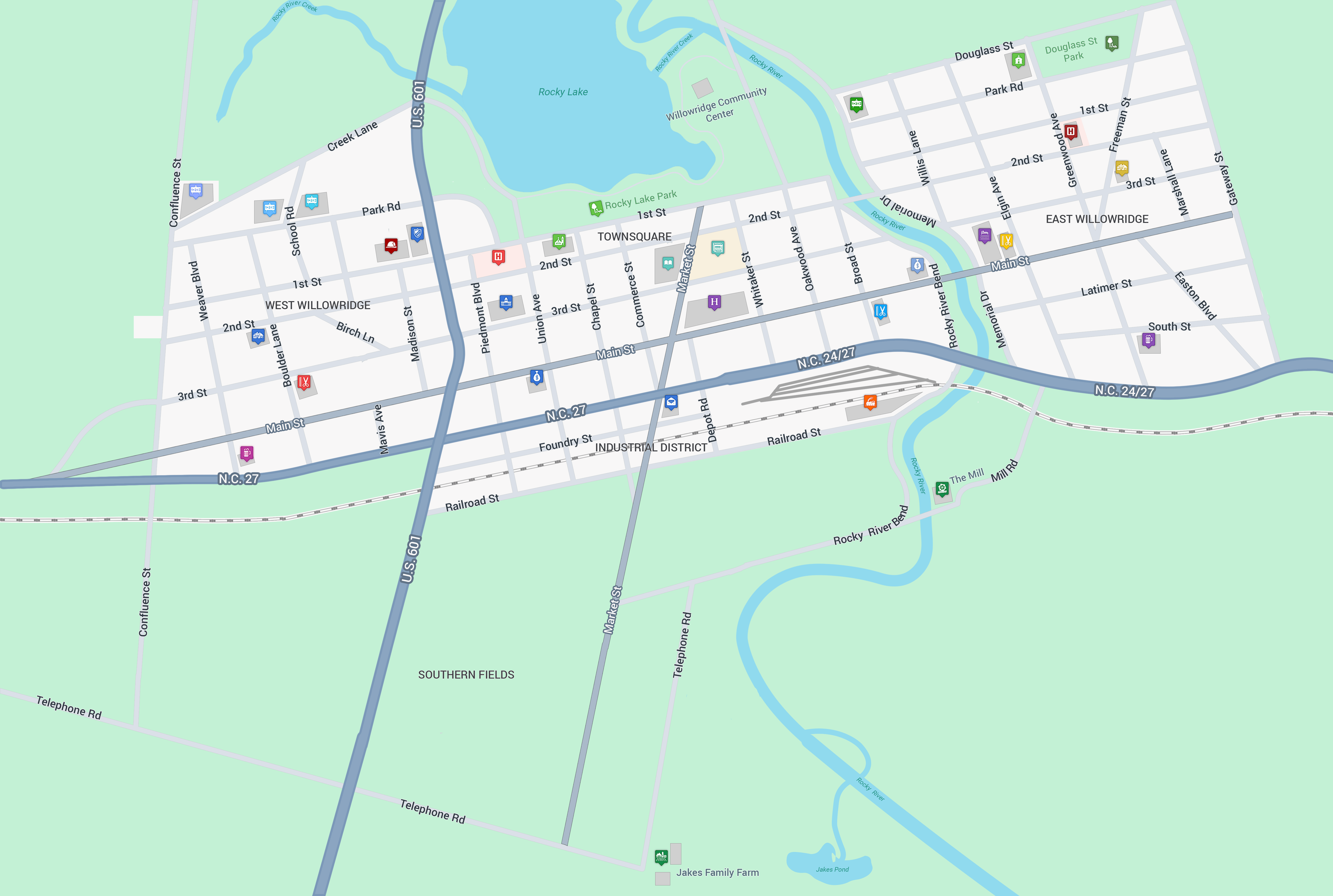
Jakes Family Farm | Hedge Farms
Original name of the Jakes property and Walter Hedge’s later name for the same farm property
King House
Judd and Mattie’s home at Third Street and Freeman Street
Jakes house
Ethan and Sarah’s home at Second Street and Boulder Lane
The Palmetto
Hotel where Walter Hedge stays
Alma’s house
Alma King’s home and the family’s refuge after the fire
New Hope
Church/community that assists the Kings
People’s Savings Bank & Trust
Black-owned bank near Main Street and Rocky River Bend
The First National Bank
White bank across Townsquare
Sheriff’s Substation
Located in West Willowridge, where Judd goes to file a report
The Mill
Cotton gin near Rocky River in the Industrial District
Second street bridge
Second ridge crossing Rocky River
Main Street Bridge
Bridge crossing Rocky River
FROM A SKETCH ON PAPER TO A TOWN I COULD BELIEVE WAS REALLY THERE
MAP A — WILLOWRIDGE ON PAPER
Willowridge began with a pen, a sheet of paper, and a fairly simple problem: I needed to know where everything was.
When I first drew the town, I was not thinking like a city planner. I was thinking like a novelist. I needed a white side and a Black side. I needed the farms south of town, businesses in the center, roads that could carry characters where the story needed them to go, a railroad, water, schools, churches, homes, and enough open space that Willowridge felt like a Southern town rather than a few streets built for the plot. So I drew what I could see in my head.
Street by street, the place began taking shape. I marked where Judd lived, where Ethan lived, where people worked, where the railroad crossed town, where the agricultural land opened up, and which parts of Willowridge belonged socially to which communities. It was rough, handwritten, crooked in places, and covered in notes, but for the first time I could look down and see the town my characters had been moving through.
That first sketch gave Willowridge its bones. It also gave me a problem I did not recognize yet.
MAP B — THE FIRST WILLOWRIDGE
Once I had the hand-drawn version, I brought it into Photoshop and rebuilt it in a style inspired by modern digital maps. Google Maps obviously did not exist in 1942, but that was never the point. I was not trying to create an artifact Judd King might have unfolded in his truck. I wanted a reference map I could read quickly while writing.
That style worked for me because it made the imaginary town feel strangely real. Streets had weight. Highways looked like highways. Buildings could be marked. The railroad had a visible route. Neighborhoods stopped floating around in my imagination and took up real ground.
More importantly, the finished map still looked like my drawing, and I was proud of that. I had taken something that existed on a sheet of paper and translated it almost exactly into a clean map of Willowridge. The town looked organized. It looked readable. It looked like somewhere you might actually find if you kept driving long enough outside Charlotte.
The trouble was that I had designed the roads according to what I wanted them to do, not according to what roads actually do. That became one of the lessons of the First Edition. Fiction gives you enormous freedom, but once you place an invented town inside a real state, near a real city, and connect it to real regional geography, some of that freedom comes with responsibility. My highways looked convincing on the page because I had drawn them with the visual language of a real map. Underneath that appearance, the routing didn’t hold up.
I had drawn the town first and asked reality for permission afterward. For the Second Edition, I decided to reverse that.
MAP C — FINDING THE GROUND
I went looking for Willowridge. Not literally — there was never going to be a forgotten North Carolina town waiting for me with a sign at the city limits. What I needed was real geography capable of supporting the fictional place I had already imagined.
I spent time looking around North Carolina on Google Earth, studying the roads outside Charlotte and searching for something deceptively simple: a useful meeting of a United States highway and a North Carolina highway that could give Willowridge a believable regional skeleton. That search eventually brought me to the country north of Midland, North Carolina.
There it was. U.S. 601 running north and south. N.C. 27 crossing the region, with the N.C. 24/27 corridor nearby. Rocky River moving through the surrounding countryside. Locust to the east. Stanfield farther southeast. Charlotte close enough to remain the major city that mattered beyond Willowridge. It gave me the structure I had been missing.
There was one obvious complication. Midland was sitting where Willowridge wanted to be.
I could have moved Willowridge somewhere else, but by then I understood what I wanted from the Second Edition. I was not trying to insert my town invisibly into modern North Carolina and pretend every community around it had to remain untouched. The Cotton King already takes place in a fictional version of the state. So I made a choice: in the North Carolina of The Cotton King, Midland does not exist.
Locust remains to the east as another smaller community. Stanfield remains farther southeast. Charlotte remains the major geographic anchor. The real highway and river system gave me something solid to build from, but the land Midland occupies in our North Carolina became the space where Willowridge could grow. I did not want to copy Midland. I wanted its geography — and that distinction became important.
MAP D — WILLOWRIDGE, REBUILT
The final step was to take those real geographic bones and build Willowridge over them.
U.S. 601 became one of the town’s major north-south anchors. N.C. 27 and the N.C. 24/27 corridor established the principal east-west regional movement. Rocky River became part of Willowridge’s physical identity, flowing through the fictional landscape and connecting northward into Rocky Lake. Around those features, I rebuilt the town I had originally drawn. West Willowridge remained the principal white residential side. East Willowridge remained the heart of the Black community. Townsquare remained between them as the commercial and civic center where people could occupy the same streets without living under the same rules. The Industrial District grew naturally around the highway and railroad corridor. The Southern Fields opened below the developed town, where Market Street and Telephone Road eventually led toward the Jakes farm.
The places I cared about survived. The geography underneath them became stronger.
That change affected more than the map. Once I knew where everything actually sat, movement through Willowridge started telling part of the story. Judd leaving his home in East Willowridge and crossing the river is not simply transportation. He is moving between communities with different expectations and different kinds of power. Ethan can drive home to West Willowridge after working beside Judd all day and enter a part of the same town that does not belong to Judd in the same way. Townsquare becomes a shared civic center without becoming integrated. The highways carry people toward Charlotte and the wider world, while the railroad connects this little agricultural town to a country at war. Geography began producing consequences, and that’s when Willowridge finally felt complete to me.
The Second Edition map is still fictional. Rocky Lake is mine. The arrangement of the streets is mine. East and West Willowridge, the businesses, the farms, the districts, and the history those places carry belong to the novel. Even the version of North Carolina surrounding the town is not meant to reproduce our world perfectly. But now the fiction has something beneath it. I could point to the real landscape that inspired the placement. I understood what the highways were doing before I asked my fictional streets to meet them. I knew where Charlotte sat beyond the map. I knew what communities would be nearby and which one I had deliberately removed to make space for Willowridge.
The funny thing is that the finished Second Edition map still looks like the town I drew by hand. That may be my favorite part of the whole process. I did not have to throw away the place I originally imagined. I had to understand it better.
The first map showed me what I wanted Willowridge to be. The second taught me that looking real and being believable were not quite the same thing. The third gave me ground sturdy enough to build on. And the fourth became Willowridge.
Not a real town. But now, at least to me, one that knows exactly where it is.
INHERITANCE, SOIL, AND WHAT ONE GENERATION LEAVES THE NEXT
The Kings do not inherit land at the beginning of The Cotton King. They inherit what they know about it.
Titus King worked ground belonging to Harrison Jakes. Haywerd worked the same farm after him. Judd grows up learning fields his father learned from his father, until that knowledge becomes nearly physical. He knows where water settles after rain. He knows which ground dries first, where roots struggle, when the color of a leaf is warning him about insects and when it is telling him something entirely different. He can read a field because generations of Kings have been teaching one another how.
Yet none of that knowledge appears on a deed. That is one of the story’s central tensions: a family may pour decades of labor into a place without owning it. They may improve soil they cannot sell, repair fences they do not own, restore exhausted ground, increase another family’s harvest, and leave behind evidence of themselves that the law does not recognize as ownership.
But land keeps records of its own. A ditch changes because somebody dug it. Soil becomes richer because somebody cared for it. A tree grows where somebody once chose not to cut it down. A child learns where to put his hands because his father showed him, and that father learned from another man whose footprints have long since disappeared.
That is where the supernatural heart of The Cotton King lives. The King blessing does not arrive in Judd’s life like a new power — he has carried it all along. The family story reaches into generations before Titus, back to ancestors who survived slavery and carried forward a connection between King blood, sowing, abundance, and Oshun. What Judd calls experience, luck, preparation, instinct, and good farming has always contained something else. The miracle hides inside ordinary biological life: germination, root vigor, resistance, recovery, water efficiency, fruit retention, seed viability, and the stubborn ability of something living to survive when it should not.
That distinction matters, because the novel is not interested in replacing labor with magic. A seed still has to be planted. Cotton still needs time to flower. A boll still has to mature. Someone still has to bend beneath October sun and pick what grew. The blessing does not make farming unnecessary; it makes the accumulated knowledge of the Kings harder to separate from the extraordinary thing traveling beside it.
And inheritance, in this story, is never limited to blood. Judd inherits Haywerd’s knowledge. He inherits Alma’s stories. He inherits Titus’s place in Willowridge and the complicated history between the King and Jakes families. He inherits the consequences of a world none of them created. Then J.J. and Coretta stand behind him, waiting to inherit whatever Judd decides to preserve, reject, understand, or change.
Near the end of the novel, Judd teaches his children something every farmer already knows: you do not put seed into the ground and demand proof the next morning. You sow. You tend. You wait. The novel asks what happens when families must do the same with a future.
The land remembers what people put into it. The harder question is what their children will do with what grows.
NOTES ON WRITING, HISTORY, AND THE MAKING OF A NOVEL
The Cotton King came to me in a dream.
The first version of this book came from that initial idea and the excitement of realizing I could actually turn it into a novel. I wrote it, finished it, published it — and for a while, I thought that was the story.
Then I kept learning.
I started doing more research, not only into 1940s North Carolina, farming, Jim Crow, and the lives of the people who would have inhabited a place like Willowridge, but into the craft of writing itself. I studied writers and storytellers, including Margaret Atwood’s lessons on fiction, and began looking harder at character, voice, point of view, conflict, and what makes a story feel lived in rather than simply told. The more I learned, the more I realized I wanted to return to Willowridge.
So I did something I never expected to do: I rewrote the entire novel.
The original story was much broader. It followed what happened when these characters succeeded, built something bigger, and eventually found wealth and recognition. In revisiting the book, I became less interested in how large their lives could become and much more interested in the people living those lives.
Judd became the center.
Instead of everyone sharing equal space in the story, the people around him became part of his journey — his wife, his children, his friends, the men he works beside, the people who help him, and the people who threaten everything he is trying to protect. Characters who once stood quietly in the background were given voices of their own. Clarence became Clarence instead of simply another farmhand. Conversations became friendships. Families gained history. People disagreed, joked, complained, worried, lied, loved one another, and sometimes said the wrong thing. Ethan’s friendship with Judd had to stay genuine without pretending friendship could erase Jim Crow. Mattie needed a life larger than worrying about her husband.
Even Peter Whitley changed. I did not want him to exist simply as “the racist villain.” I wanted to understand how resentment grows around wages, status, gossip, and what a man is willing to call fairness — how hatred can be made to sound reasonable to the people listening, and how that kind of thinking builds toward something much uglier.
Willowridge changed with them.
I drew maps. Then I redrew them. I researched North Carolina roads, farms, rivers, towns, transportation, agriculture, segregation, businesses, neighborhoods, and what life in 1942 would actually have demanded from the people living there. Eventually Willowridge found its home in the North Carolina Piedmont, near Charlotte, shaped around real geography while remaining entirely its own fictional place — and it stopped being a backdrop. It became somewhere I could tell you how Judd gets from his house to the farm, and which streets would treat him differently than they treat his best friend. That changed the writing, because geography creates consequence.
The farming had to become just as specific. I had to learn when cotton should be planted and when wheat ought to be cut, what a boll weevil actually damages, what a farmer notices before an ordinary person notices anything, what a 1942 crop might be worth, how a half-share arrangement could remain unfair even if the landowner kept honest accounts, and why gasoline, tires, machinery, and farm labor were so much harder to secure after the United States entered the war. The more specific the world became, the less room there was for history to serve as decoration.
That work changed the supernatural side of the book too. I did not want the King blessing to turn Judd into a wizard standing in a cotton field. The impossible needed to belong to the same physical world as everything else. Seeds germinate. Roots search for water. Plants survive insects. Damaged growth recovers. A farmer sees something happening that should not be happening and keeps looking for an ordinary explanation, because ordinary explanations are what his whole life has taught him to trust. Not a man discovering that he is powerful — a man discovering that what was handed down to him was larger than he understood.
I built family histories stretching back generations, because the lives of Judd King and Ethan Jakes in 1942 could not exist without asking how their families arrived at that moment. Who owned the land? Who worked it? Who inherited what? What did slavery, Reconstruction, Jim Crow, and decades of farming leave behind? Eventually I had maps, timelines, family trees, character histories, agricultural research, rules for the supernatural elements, and what became essentially a lore bible for a little North Carolina town that does not exist.
And somewhere in all of that work, The Cotton King became a different book. The ending changed. The journey changed. The characters changed. The earlier version looked ahead toward what the Kings might eventually build; this one became more interested in what has to happen first — what it means for Judd to claim his own life, what ownership means to a man whose family has improved another man’s ground for generations, and what he wants to leave J.J. and Coretta. There is even an epilogue now that feels less like an ending to me and more like the final answer to the question the book has been asking all along.
Pieces of the original are still in there. There should be. The humor survived. The friendships survived. The family survived. The strange green rows survived. What changed was everything holding them up.
When I released the original version, I knew I had finished a novel. I wasn’t sure I had written the novel I wanted The Cotton King to be.
Now I am.
And I am genuinely curious to see what readers think of Willowridge the second time around.
Timeline
Story Timeline
Follow the King family and the events that shape their place in Willowridge.
1896
The Kings Come to Willowridge
Titus King arrives with his family and begins the King family’s long relationship with the land.
1917
Judner King Is Born
A new generation inherits the family’s knowledge of farming, work, and Willowridge.
Late June 1942
The Story Begins
Judd notices that neighboring cotton is suffering damage while his eighteen acres remain different.
July 1942
The Farm Changes Hands
The Jakes farm is sold, disrupting a relationship between families that has lasted for generations.
August 1942
Judd Takes Authority
As the season worsens, Judd begins negotiating from the value of what he knows rather than accepting his old place.
August 1942
Resentment Grows
Peter Whitley’s resentment of Judd’s authority becomes increasingly racial and dangerous.
Late August 1942
Fire Comes to East Willowridge
Violence reaches Judd’s home and family, permanently changing the stakes of the harvest.
Early September 1942
Judd Returns to the Farm
Three days after the fire, Judd returns to work and finds his eighteen acres still green.
Middle of September 1942
Cotton Bloom
White begins appearing across the field, and the harvest begins under guard.
First Week of October 1942
The Harvest Is Attacked
An attempt is made to destroy the crop, but the attacker is caught and the evidence leads back to Peter.
October 1942
Twenty-One Bales
The eighteen acres produce twenty-one bales, and Judd finally accepts that the blessing is real.
November 1942
Judd Names His Price
Instead of asking for a higher wage, Judd asks for the one thing the Kings have never possessed: land.
November 25, 1942
King Land
Judd and Mattie King receive the deed to thirty-two acres, making the family owners for the first time.
Late November 1942
Hedge-King & Co.
A new sign rises beside Telephone Road, placing KING beside HEDGE as an equal name.
December 1942
The Next Crop Begins
Winter wheat is planted on King-owned land, and the next season starts before the year is out.
June 1943
The First King-Owned Harvest
The Kings gather the first crop planted and raised on land in their own name.
Around 1950
H.K.J & Co.
Ethan and Sarah return with land of their own, and the partnership becomes Hedge-King-Jakes & Co.
November 1958
What They Sowed
Sixteen years later, the family, the business, and Willowridge itself all carry the consequences of 1942.
Beyond the Page
Explore articles, notes, and features connected to The Cotton King. Some pieces may discuss story details.
Aug 27, 2026
The Cotton King Is Available Now
In 1942 North Carolina, Judner “Judd” King knows cotton better than anyone in Willowridge. But when something impossible begins growing through his fields, the…
Aug 27, 2026
Welcome To Asterrow Books
Asterrow Books is built around one thing: the story. Every book gets room to have its own identity, its own world, and its own…