

Alive Pays Better
An R. L. Alexander Novel
Finding a man was one thing. Bringing him back breathing was another.
Choose Your Edition
Alive Pays Better
Genre
Western · Sci-Fi
Setting
VannicYur
Availability
Preorder
Format
Paperback · Hardcover · eBook
Edition
First Edition · 2026
ISBN
9798982013323
Publisher
Asterrow Books
Length
180 pages
Beyond The Page
When I started thinking seriously about Hunter’s Eye, I was coming off a very different kind of creative experience. The Cotton King had been fun to write, and I loved developing Judd, his family, Willowridge, the history around them, and all the small details that made that book feel real. At the same time, I wanted my next project to give me a different kind of freedom. I wanted to write something faster on its feet, something that could move from one dangerous job to another without needing every story to carry the entire weight of a family saga. I wanted a protagonist who could walk into a town, take a contract, follow a trail, get into trouble, finish the work, and leave with the consequences still attached.
That became Hunter’s Eye. The idea was never to make the world smaller. In some ways, Yur became one of the largest settings I had ever built. I wanted to make the unit of story smaller. I wanted to tell a hard, contained adventure about one person who needs to be found, one trail that refuses to stay simple, one settlement with a problem, or one contract that becomes something different once the facts start coming in. That structure let me build a world with deep history while keeping the actual reading experience close to the road. The world can be ancient. The job in front of Gwyon still has to be solved today.
I also wanted the series to feel fun without making it weightless. Gwyon Djem-Sun is dangerous, experienced, and capable, but he is not superhuman. He can miss something. He can be injured. His equipment can fail. He can be outnumbered, lied to, trapped, exhausted, or simply wrong. His body has limits, his ammunition has a count, and every piece of Tek that helps him also gives him something else that can break. The pleasure for me is not watching an unstoppable man prove that nobody can touch him. It is watching a very good man at a very difficult profession figure out what remains possible after the easy choices are gone.
Spoilers Ahead
THE STORIES AND CHARACTERS THAT HELPED ME FIND GWYON
Gwyon came together from several influences, each for different reasons. The Witcher was about structure more than character; the appeal of a traveling professional and a job that can be finished. The Good, the Bad and the Ugly gave me the visual and moral language of a Western where competent people can be dangerous, funny, selfish, principled, exhausted, and impossible to file under one clean label. Django Unchained gave me something else: Black Western presence, style, anger, violence, and the specific pleasure of watching a Black man occupy a genre space that American popular culture spent a long time pretending men like him were never in.
Batman influenced a completely different part of the character. What I have always liked most about Batman isn’t that he can fight everybody in the room. It is the detective. He notices, reconstructs, tests, compares, and understands that solving the problem often means asking a better question than the people who called him. I wanted that investigative pleasure in Gwyon without making him a man who always knows the answer. The Hunter’s Eye supports that side of him, but it never replaces it. If the Eye can see a difference in soil, blood, heat, stride, or wear, Gwyon still has to decide what that difference means and whether another piece of evidence agrees.
Those influences meet in a character who can walk into a rail town looking like a Western gunslinger, spend the next day buried in freight manifests and survivor statements, deliberately let the people he is hunting escape because a living trail is worth more than an easy corpse, and then discover that the job is physically harder than his damaged body can comfortably survive. That combination is Gwyon to me. The gun matters. The road matters. The investigation matters. The person at the end of the track matters most.
I also wanted his Blackness to be visible without turning Yur into a coded copy of modern America. Gwyon is a Black man because I wanted him at the center of the Western. Yur has its own histories of ethnicity, Changed peoples, empire, slavery, migration, religion, and prejudice, and those systems can be brutal without becoming a one-to-one substitution chart for Earth. He does not need the setting to explain him. He belongs in it.
A WESTERN AT THE END
The Western came first. Before I knew every state on the map or every period in Yur’s history, I knew I wanted dust, riders, rail lines, lonely roads, hard settlements, armed men arguing over jurisdiction, people making a living at the edge of somebody else’s authority, and a stranger who arrives because the local system has reached the end of what it can do. I wanted the silhouette to be recognizable even when the world around it was not. A hat, a poncho, a weapon, a long road, and the sense that the next town may have a completely different idea of what the law means are all part of the foundation.
The post-apocalyptic side of Yur works a little differently from the endless-wasteland version of the idea. The world did not end and stay ended. Civilizations collapsed, rebuilt, inherited pieces of older systems, lost knowledge, recovered some of it, fought over what still worked, and built new countries on the remains. Railways, foundries, farms, bureaucracies, ports, courts, armies, hospitals, religious institutions, markets, and universities remain. There are also ancient pumping systems nobody can completely reproduce, ruined industrial corridors beneath modern roads, political borders that stop mattering a day’s ride outside the last garrison, and pieces of machinery older than the governments claiming ownership of them. The apocalypse is history, but history is still physically under people’s feet.
That is also where the fantasy part of the setting lives. I wanted fantasy without operative magic. People on Yur have religions, spirits, gods, sacred traditions, visions, rituals, and sincere faith, but the setting does not hand the reader an author-confirmed spell system that solves material problems. Wonder comes from engineered biology, the Changed peoples of Yur, lost infrastructure, strange geology, cybernetic medicine, forgotten civilizations, and the fact that modern people are living among technical achievements they can sometimes maintain better than they can understand. The world can feel fantastical without asking a character to cast anything.
WHY THE NAMES SOUND HUMAN
The names in Hunter’s Eye are meant to feel changed, not disconnected from humanity. I did not want Yur populated by names that sounded as if they had been assembled only to prove the setting was fantasy. My starting point was the idea that these are still human cultures separated from familiar history by enormous stretches of time, migration, language change, conquest, translation, local pronunciation, and spelling drift. If a reader looks at a name such as Gwyon, Bhe’shopp, Tohmis, Mikhael, or Khaeleb and feels that there might be an older human name somewhere underneath it, that is intentional. Bhe’shopp was Bishop. Khaeleb was Caleb. Gwyon has Guion somewhere back in it. None of those are secrets, and none of them are puzzles I expect anybody to solve; they are the residue of a few thousand years of people saying a word slightly wrong until the wrong version became correct.
That does not mean every name gets the same amount of distortion. If every person had three apostrophes and two hyphens, the result would stop feeling like language and start feeling like decoration. Some names remain close to familiar forms. Others drift more aggressively through vowel change, consonant substitution, syllable breaks, older spellings, or cultural mixing. Place names work the same way. Some are translations in Common Trade Speech. Some preserve older local terms. Some come from geography, a dynasty, an occupation, an institution, or a mishearing that stuck for three hundred years until the mistake became the correct name. I like that approach because it supports one of the larger ideas behind Yur. This is not an alien civilization wearing human clothing. These are people. Their world has changed almost beyond recognition in places, but continuity remains in language, bodies, work, family, politics, religion, and the way humans keep naming new things with pieces of old words.
GWYON DJEM-SUN
Gwyon was never supposed to be a mystery-shaped coat with a gun inside it. I wanted the reputation of “the Stranger” to sit on top of a life that explains both his competence and the things he still cannot do well. He is thirty-five when the series opens, which is how old I was when I wrote him. I did not plan that, and I noticed it late, but it explains some things about the book. Thirty-five is old enough to be good at something and young enough to still be paying for how you got good at it. Most people encounter him after the reputation already exists. They see the hat, the Hunter’s Eye, the Bottom-Feeder, the saber across his back, the controlled way he watches a room, and the fact that he asks questions other people did not think to ask. The person underneath all of that began somewhere much less impressive.
Gwyon was raised in a nomadic Brell community that moved through established circuits rather than living in one permanent settlement. His family and the people around them knew roads, water, grazing, weather, temporary markets, camps, work, danger, and the difference between a stranger passing through and somebody paying too much attention. That matters because Gwyon didn’t wake up one day with a supernatural gift for tracking. He learned to read country as a child because reading country was part of staying alive. Later, House Malor turned that practical knowledge into a profession, but the foundation came from the life he lost.
That childhood ended when Tek Raiders attacked the encampment. The Raiders were not simply looters looking for crates. They wanted machinery, including machinery that had already become part of human bodies. People with useful prosthetics, mechanical joints, optical components, nerve contacts, and other valuable Tek were killed or mutilated so those parts could be removed and sold. Gwyon’s parents were killed, the wider community was shattered, and the structure that should have absorbed an orphaned child broke apart with it. For a period of his childhood, he survived between settlements however he could, sleeping where it was safe, begging, scavenging, stealing when he had to, and leaving before a place could become another trap. Then Bhe’shopp Teyte found him. Bhe’shopp was already an established Man-Hunter of House Malor, and what started as one adult taking responsibility for a child became the second half of Gwyon’s upbringing. He brought Gwyon to Wamsalor in the Greyspine, gave him structure, taught him to read more than tracks, and eventually trained him through the Long Track. Their relationship matters because Bhe’shopp is not merely a combat teacher or an old master placed in the story to hand over techniques. He is the person who gave Gwyon a place after Gwyon had learned that places could disappear. He is also one of the few people who can tell Gwyon he is wrong and expect him to listen. The fact that Bhe’shopp is widely believed to be ancient is one of those pieces of Yur I am perfectly happy not explaining yet.
WHAT A MAN-HUNTER ACTUALLY DOES
The easiest way to describe a Man-Hunter is to say that they find people when ordinary systems cannot. That can sound like a bounty hunter until the work gets specific. A marshal may have authority inside a district. A soldier may control a road. A company investigator may have access to company records. A local guard may know every person in one settlement. The problem begins when the person being sought crosses a border, changes a name, moves through a No Man’s Land Zone, boards a ship, enters a religious estate, disappears into a mining territory, or simply goes somewhere the client’s legal authority cannot follow. A Man-Hunter is trained to keep the human track moving after jurisdiction stops being simple.
That track is much larger than footprints. A person needs water, food, shelter, money, transport, medicine, tools, relationships, papers, habits, and places where they feel safe enough to stop looking over their shoulder. An injured person moves differently from a healthy one. A rider with a tired animal cannot make the same choices as a rider with a fresh mount. A false name still has to survive questions from people who remember faces, accents, debts, family connections, or what was bought yesterday. Records matter. Witnesses matter. Freight matters. Medical treatment matters. The shape of a route matters. A good Man-Hunter is not somebody who looks at one broken twig and announces the whole solution. They build a person out of consequences.
There are only five surviving Man-Hunter Houses in the present era, and there are only about one hundred twenty-five fully initiated Man-Hunters alive across Yur. The Houses are not a secret global government, and they do not dress every hunter in a uniform. They are surviving professional lineages, each shaped by the country and problems around it. House Malor in the Greyspine is Gwyon’s House. Raedhen grew around long overland pursuit and hard dry-country logistics. Veysk developed near a different political and geographic seam. Karsen operates from Drust. Silstane is the newest House and comes out of Ossan. The important part is that a House preserves methods, training, records, medical knowledge, Eye fitting, obligations, and professional memory. It does not make every person inside it morally identical.
That last point is important to the series. A Man-Hunter title proves training. It does not prove goodness. Some hunters take work Gwyon would refuse. Some accept contract killing. Some work closely with states, companies, or political patrons. Some are financed through businesses and property. Some are compromised. Others may be better people than Gwyon in ways he does not recognize. I do not want the profession to exist just to confirm that my protagonist represents the one correct version of it. I want meeting another Man-Hunter to tell the reader something about another way this same profession can survive.
THE LONG TRACK, THE BLOOD OATH, AND THE EYE
Becoming a Man-Hunter is deliberately difficult because I wanted the title to mean something beyond carrying unusual equipment. An apprentice trains through the Long Track, an extended period of supervised work meant to prove that the student can eventually operate alone. The Track covers investigation, fieldcraft, survival, travel, contracts, evidence, medical judgment, weapons, people, jurisdictions, and the thousand small logistical decisions that become life-or-death problems once nobody is standing nearby to correct you. It is not a classroom test. It is the transition from being protected by somebody else’s experience to being responsible for your own decisions.
Finishing the Long Track does not automatically make the apprentice a Man-Hunter. The candidate still has to accept the Blood Oath. The name is not symbolic. The candidate consciously gives up a natural eye without anesthesia before the Hunter’s Eye is fitted. I wanted that choice to stay severe because it explains why the profession is small and why the Eye cannot be treated like a cool gadget somebody buys because they have enough money. The oath asks whether the person wants this life badly enough to permanently alter the body that has to live it. The Houses can be medically competent and still make that decision terrifying. In fact, I think it is more unsettling when everyone in the room knows exactly what they are doing.
Assassin’s Creed was somewhere behind that. The early members of the Brotherhood gave up a finger, and what began as a practical requirement of the weapon eventually outlived the weapon and survived as ceremony. I liked that shape, and then I found myself wanting the opposite of it. Nothing about the Hunter’s Eye is left over from an older necessity. The Houses did not inherit a sacrifice and keep performing it out of habit. They decided what the profession should cost and built the cost into the door. A ritual that survives its own reason tells you something about tradition. A ritual designed to be exactly this severe tells you what an institution thinks it is buying.
The Hunter’s Eye is the only standard piece of personal equipment the Houses provide. Everything else is the hunter’s choice. That means Gwyon’s massive Bottom-Feeder, straight field saber, clothing, restraints, maintenance kit, mount, and other working gear belong to him and to his way of doing the job. Another hunter may look completely different. The Eye is the shared mark because every fully initiated Man-Hunter has made the same permanent exchange to enter the profession.
Even then, the Eye does not make a Man-Hunter omniscient. It can magnify, compare, retain patterns, help separate heat, examine close detail, improve usable contrast, and reveal information an unaided eye might miss. It cannot tell Gwyon what happened. It cannot decide whether a witness is lying. It cannot identify the meaning of a footprint simply because it can measure it more precisely. It gives him better information and, occasionally, better ways to be confidently wrong. That limitation is one of my favorite parts of the concept because it keeps the detective work human.
THE HUNTER’S EYE IS NOT A SUPERPOWER
Much of the worldbuilding around Gwyon comes from one rule: help is not the same as invulnerability. His Hunter’s Eye helps him see more, but it can strain, misalign, collect grit, react badly to abrupt light changes, or require maintenance. His body has been rebuilt around old injuries, but the machinery that keeps him moving still has seals, fittings, anchors, pressure, cable tension, scar tissue, and biological tissue underneath it. In Alive Pays Better, his damaged biological left arm is still present beneath a pressure-assisted brace, and his lower body is supported by the older Waybrace. Those systems help him work. They are also failing architecture he’s been asking too much of for too long.
That matters because I never wanted cybernetics in Hunter’s Eye to function like a clean upgrade screen. Tek is body machinery. It can improve a person’s life enormously, but it creates maintenance, expense, pain, and dependency. A prosthetic hand can be stronger than a biological hand in one task and worse in another. A brace can let somebody walk farther while slowly damaging the tissue carrying its load. A sealed military system may perform beautifully until the one component it needs is unavailable three borders away. A cheap industrial prosthesis may look crude and keep working for twenty years because every shop on the route understands how to repair it.
Gwyon becomes more mechanically reconstructed after Alive Pays Better, including a full Forgearm and improved lower-body support, but I do not see that as a path toward turning him into a superhero. It changes where the weaknesses are. He can gain strength, precision, or reliability while becoming more dependent on maintenance, calibration, fittings, and the integrity of the interfaces between machinery and flesh. A better system can fail in a more complicated way. That feels much more interesting to me than treating every new piece of Tek as a permanent increase in power.
TEK: THE FUTURE REBUILT WITH WRENCHES
Tek is probably the clearest example of the exact mixture I wanted from Hunter’s Eye. I wanted cowboys, trains, old roads, levered machinery, weathered metal, and animals, but I also wanted artificial eyes, prosthetic limbs, pressure-assisted braces, nerve contacts, surgical reconstruction, and people whose bodies have become partly mechanical. The key was making those things belong to the same material world instead of feeling like a futuristic layer pasted on top of a Western.
On Yur, Tekware is machinery integrated into the body for prosthetic replacement, structural support, sensory enhancement, work, or physical assistance. Some of it can be built by modern artificers. Some depends on Remite-derived parts or techniques. Truly ancient Before systems may be beyond current manufacturing even when people can service or adapt pieces of them. The result is uneven technology by design. A mining town may understand a brutal mechanical Workhand perfectly. A wealthy city hospital may fit a responsive prosthesis with fine nerve contact. A frontier traveler may choose the uglier system because it can be repaired by three different mechanics between here and the coast.
I also wanted the machine to remain a machine. Bearings wear. Pressure leaks. Dust gets into seals. Scar tissue changes the fit. Nerve contacts become unreliable. Lubricant behaves differently in cold weather. A prosthetic anchor still has to transfer force into a living skeleton. Tek can be liberating and painful at the same time. It can mark wealth, injury, military service, profession, punishment, debt, religious controversy, or personal choice. That gives it a social life beyond the visual design.
The world around Tek also reacts to it. The High Convent may distinguish between replacing what was lost and changing a body by choice, with different communities drawing that line in different places. Militaries want systems that keep soldiers useful. Employers may fit laborers with machinery because a prosthesis costs less than losing a trained worker. Criminals strip bodies because high-grade components can be worth more than the person carrying them. The Tek Raiders who destroyed Gwyon’s childhood are one brutal expression of a much larger truth: in a world where body machinery has value, somebody will eventually decide a human being is only the packaging.
YUR: A WORLD THAT SURVIVED ITS OWN HISTORY
Yur is roughly the size of Mars, about 6,800 kilometers across; small next to Earth, but large enough to hold dramatically different peoples, climates, states, religions, technologies, and histories. I wanted a map big enough for a lifetime of tracks without making every journey across it take a year. A single road can carry Gwyon from a place still using animal traction and hand pumps into a city with rail yards, electric lighting, telegraph offices, precision machine shops, surgical prosthetics, and working infrastructure older than the country that owns it. That unevenness is not a mistake in the setting. It is one of its main ideas.
There are four principal continental masses: Ossan in the west, Edras in the center, Casara in the east, and Sular in the south, with the fractured Norr Shelf above them and the colder Sable Shelf below. People on Yur tend to sort one another by direction in Common Trade Speech: Westlanders, Midlanders, Eastlanders, Southlanders, Norrlanders, Sablefolk. Those labels are useful at a distance and useless up close. A sailor from a naval city, a foreman from a mining interior, and an islander from a shallow-water federation can all be called Westlanders while living in three political realities that have almost nothing to do with one another.
The planet is dry overall, but I did not want “dry world” to become a permanent desert filter over everything. Water exists. The struggle is usually about making enough of it reliable. A household can settle, filter, boil, or distill what it needs. A city, army, railway, foundry, or agricultural region needs pumps, reservoirs, aquifers, canals, treatment works, and labor. That is what makes water infrastructure political. A state does not invade a neighbor because one person is thirsty. It invades because a pumping system keeps an industrial district alive, because a canal feeds thousands of acres, or because an ancient mountain gallery still moves water through stone centuries after everyone who understood its design died.
WHAT THE BEFORE LEFT, WHAT I WON’T EXPLAIN
I wanted Yur to have deep history without forcing the reader to memorize a creation myth before the first gunshot. The oldest major period is called the Before. That name is intentionally unsatisfying. Modern historians do not actually know whether the Before was one civilization, several civilizations, or a later category that compresses different peoples into something easier to discuss. What they do know is that Before-era sites contain engineering and manufacturing capabilities later societies could not fully reproduce. The Great Works, including deep aquifer systems, geothermal plants, buried transport corridors, pressure chambers, and enormous water projects, are among the most visible things the Before left behind.
After that came what Remite historians later called the First Nation, the first major post-Before state recognized in their own historical tradition. The First Nation was not as technologically capable as the people who built the oldest Great Works, but it understood enough to maintain, repair, and coordinate parts of that inherited infrastructure. That distinction is central to Yur: a civilization can know how to keep a machine alive without knowing how to build another one. The First Nation eventually fragmented as technical standards slipped, provinces became more independent, old systems failed, and wars were fought over the same pumps and water gates everyone needed to survive.
Centuries later, Remus rose in Edras. It called itself the Nation; later historians called it the Second Nation because it deliberately presented itself as heir to the First. Remus lasted more than three thousand years in changing forms, so I never think of it as one king, one dynasty, or one uniform empire. Its continuity came through roads, census systems, water law, administration, military service, engineering, and the idea of Remite citizenship. It built real order and committed real crimes. It made trade safer, supported large populations, and kept infrastructure alive while also using forced resettlement, occupation, penal labor, assimilation, and collective punishment. Modern states remember whichever half of that history helps them today.
The end of Remus was not one fireball. It came through accumulated failure: rising maintenance costs, declining technical knowledge, political conflict, religious violence, food shocks, succession struggles, separatism, and infrastructure systems being broken into pieces by local authorities who could no longer coordinate them. Then came the Emptying, when the capital stopped functioning as a normal city, and the records became contradictory enough that I deliberately refuse to give the setting one clean answer. What followed was the Long Fall, roughly five centuries in which the world did not become empty. It became crowded with competing authorities. Army commands became local regimes, ports became kingdoms, religious communities fortified grain, merchant houses hired soldiers, slavery expanded, and technical specialists became valuable enough to protect, own, or both. The modern world grew out of those survivors.
One of the choices I made early was that people in the present should not have complete knowledge of the deepest past. They have archaeology, religious traditions, old records, technical fragments, ruined machines, propaganda, inherited stories, and arguments between scholars, but they do not have a perfect database waiting to tell them what really happened. That is why people can say “the Before” and mean something enormous without being able to turn around and give a complete biography of the people who lived there. It is also why the Long Fall can be historically important without every farmer, rider, shopkeeper, or marshal carrying a classroom timeline in their head.
This was partly a practical decision. I didn’t want to spend years solving mysteries that didn’t need answers before I could write the first story. More importantly, I realized the uncertainty made the world stronger. Real people inherit incomplete history. Records disappear. Governments lie. Religious traditions preserve one kind of memory while losing another. Technical workers may understand what a warning means without knowing who first engraved it. A settlement can depend on a machine whose original purpose has been forgotten because the only important fact for the last four hundred years was which valve keeps the water moving. So when a character calls something a Before ruin, that does not mean the author is secretly promising a full revelation later. Some mysteries should remain part of the world’s depth. If a future Hunter’s Eye story genuinely needs to answer one of them, then the answer has to earn its place by changing the people living in the present. Until then, I would rather let the old world leave pressure on the new one than turn every ruin into a history lesson.
THE MAP OF YUR: FOUR CONTINENTS AND TWO SHELVES
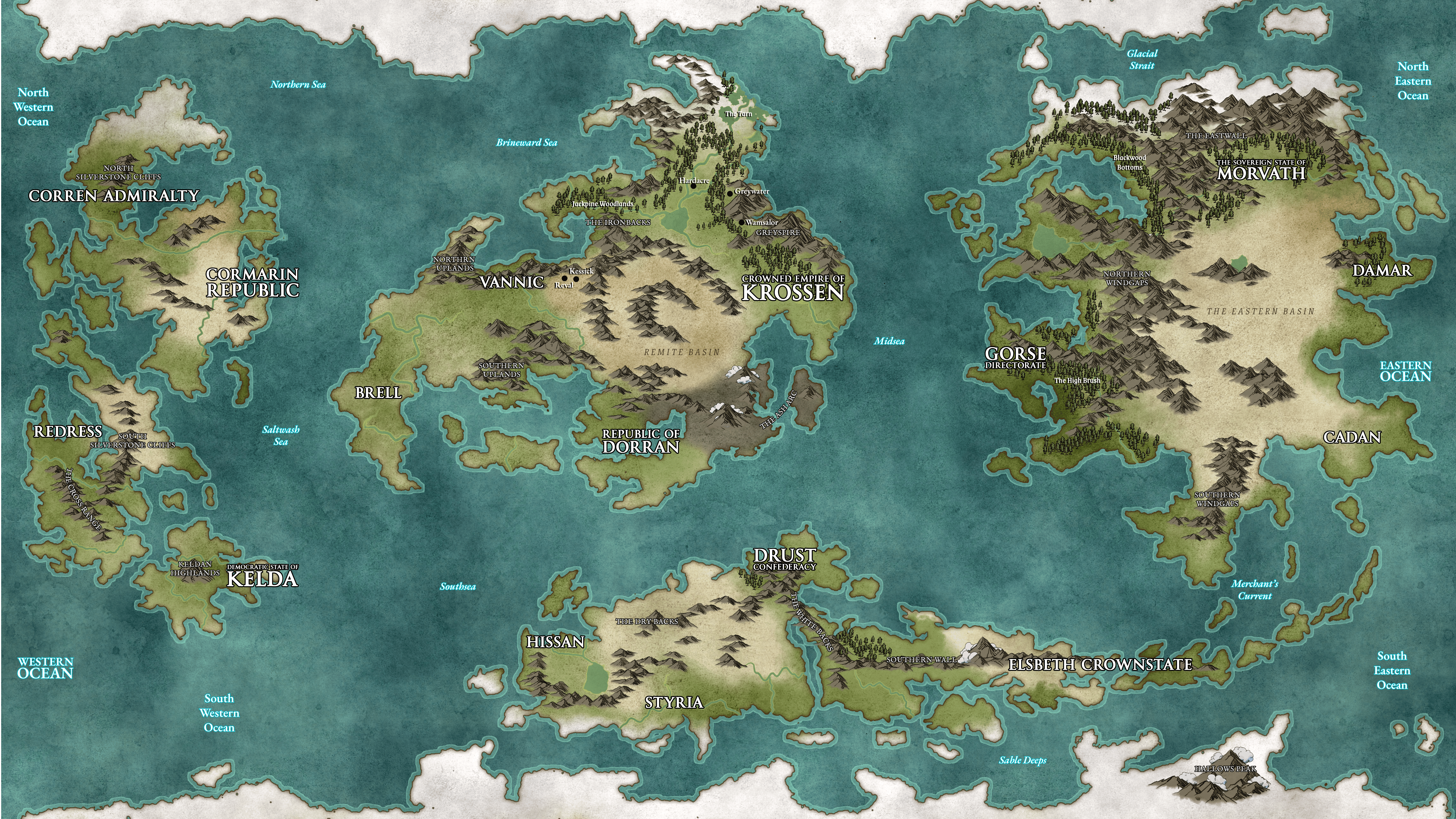
- 1
Reval | Kessick
A thinly governed stretch of broken upland and plateau country in Vannic, held together by the Reval-Basin Line. Rail freight keeps its settlements, repair yards, pumps, and trade moving, while official authority grows weaker the farther the road runs from Kessick. Kessick is Reval Township’s rail junction and administrative center, where freight, wagon traffic, repair work, commerce, and local authority converge. It is the closest thing Reval has to a center of power, though the frontier begins thinning almost as soon as you leave it.
- 2
GreyspiRe
A rugged mountain system in northern Edras, cut through with natural caves, ancient excavations, and deep aquifers. The range is one of Yur’s strongest Grendel population centers and forms a hard, isolated frontier between settled lands.
Ossan is the western broken landmass, a place where coastlines, islands, forests, uplands, harbors, and maritime trade shape politics. The Corren Admiralty is the great naval power there, but Ossan is not one naval country. The Cormarin Republic has valuable forest, agricultural, river, and freshwater resources. Redress is a mining and foundry commonwealth with strong industrial interests. Kelda survives through island knowledge, shallow straits, fishing grounds, and pilotage routes outsiders do not understand well enough to control cheaply. The West is therefore not one frontier. It can give me naval stories, mining stories, island stories, hard-road stories, and a coastal criminal economy that looks completely different from the rail country of Alive Pays Better.
Edras is the old Midlander heart of the Remite world and probably the continent most visibly haunted by inherited infrastructure. The Remite Basin dominates its center, filled with salt depressions, ruins, contaminated ground, old water systems, salvage territories, settlements, criminal networks, religious holdings, and local authorities that overlap. The Greyspine rises in the north, home to major Grendel populations and House Malor. The Ironbacks are important for mining and industry. The Crowned Empire of Krossen is the strongest conventional land power on the continent, while Vannic, Dorran, and Brell each survive by solving different political and geographic problems. Alive Pays Better begins in Vannic, but Edras is large enough that another track can feel like another world without leaving the continent.
Casara is the great eastern landmass, shaped by large river systems, old cities, powerful administrations, and the rivalry between major states. Morvath is built around institutional continuity, registries, public works, permits, and bureaucracy. Gorse is an industrial directorate organized around production, command, artillery, and strategic labor. Damar survives between those powers through diplomacy and geography, while Cadan uses ports, shipyards, trade, and commercial flexibility to remain useful to rivals who frequently dislike it. Casara gives the series a place where a hunt can move through paperwork, river systems, urban institutions, industrial districts, borders, and older political cultures very different from the road-country image people may first associate with Gwyon.
Sular stretches across the south and is shaped by trade corridors, salt, ports, volcanic influence, labor systems, and competing local political arrangements. The Elsbeth Crownstate is the major power, a state capable of broad inclusion while measuring human worth through service and productive usefulness. Hissan is wealthy, commercial, and comfortable with legal ambiguity. Drust is a confederated state with a high proportion of Changed citizens and strong local autonomy, which does not make it automatically gentle. Styria openly legalizes slavery and sells the products of that economy to foreign states that condemn it while still buying from it. Sular reminds me why the series should never reduce a continent to one visual theme or one moral identity.
The Norr Shelf and Sable Shelf sit at the edges of that larger political order. Norr is a broken, cold country of shallow seas, brine, glaciers, tundra, mineral fields, mining concessions, holds, and difficult settlement. Sable is darker, more volcanic, more isolated, and scattered with salvage communities and holdfasts around exposed rock, frozen flats, and dangerous margins. Neither is a blank polar cap. Both are inhabited places where survival, trade, resource extraction, religion, and old technology can create stories that would feel very different from the interior of Edras.
MAJOR POWERS, MINOR POWERS, AND NOBODY CLEAN
One rule I set for myself was that Yur should not have a hidden good empire waiting to solve everybody else’s problems. Every successful major power survived because it solved something real, and every solution carried a cost. Krossen made roads and industry dependable through hierarchy, militarization, conscription, censorship, and Crown claims over strategic resources. Corren protects maritime crossings with the strongest conventional navy on Yur and makes that security expensive through port control, compulsory service, and the power to decide whose ships move. Morvath can keep records, irrigation schedules, courts, and public administration functioning across generations, but the same bureaucracy that can protect someone can erase them with a revoked document. Gorse values productive capacity more than purity of body or ancestry, which can look tolerant until a person becomes less useful to the state. Elsbeth can incorporate humans and Changed people into the same civic machine while turning usefulness into a hierarchy of human worth.
The minor powers are not background decorations under those larger states. Vannic’s service-based civic culture gives local communities more voice than Krossen while making rights conditional on recognized contribution. Dorran has real elections and real oligarchic wealth at the same time. Brell turns mountain passes, toll roads, water routes, and neutrality into national survival. Damar has spent generations learning how to stay alive between two stronger neighbors. Cadan survives partly because the same powers that complain about its trade flexibility also need it. Kelda’s island federation remains difficult to conquer because local knowledge makes outsiders pay for every assumption. Redress can have stronger worker traditions than an empire and still be dominated by industrial interests. Drust can offer a more inclusive model of citizenship and still contain harsh local districts. Nobody gets to exist only as a moral label.
That political structure is useful for Hunter’s Eye because Gwyon is not a diplomat or a revolutionary leader. He moves through systems already in place before he arrived. A contract that is legal in one place may be criminal in the next. A state that helped him last month may become the obstacle this month. He can dislike an institution and still need its rail line. He can respect a local official inside a government he does not trust. He can refuse to care which flag claims a valley and then get involved the moment somebody under that flag starts treating civilians as disposable. The politics matter most when they become pressure on the person standing in front of him.
NO MAN’S LAND IS NOT EMPTY
The phrase No Man’s Land can sound like an uninhabited wasteland, and that is exactly what I do not mean by it on Yur. These are spaces where no recognized state has enough uncontested sovereignty to make one legal order dependable across the whole region. People live there. Settlements, ranches, mines, clan territories, Grendel Holds, religious communities, old forts, trade roads, salvage sites, company property, criminal camps, waterworks, and local governments can exist there. What changes is not whether people exist. What changes is how far a promise travels.
A warrant may be respected in one town and ignored twenty miles later. A company may control a mine and have no authority on the road outside its gate. A family council may matter more than a distant national border. A Merchant’s Union contract may be the only paper two hostile settlements both recognize. A militia can enforce peace until the money runs out. That uncertainty is one reason Man-Hunters still have a profession. The world has countries, police, soldiers, courts, and registries, but those systems do not all reach the same places or recognize the same authority.
For storytelling, No Man’s Land gives me the frontier without requiring me to pretend civilization vanished. The danger can come from too many systems instead of none. Gwyon has to know who can make a deal, who can enforce it, what a local boundary means, whether the person he is tracking has protection, and whether crossing one ridge turns a lawful recovery into kidnapping. That feels much closer to the Western pressure I wanted than a generic place where “there are no rules.” There are always rules. The trouble is figuring out whose rules are real here.
ALIVE PAYS BETTER
Alive Pays Better became the first full Hunter’s Eye story because it let me introduce the profession through a problem that looks simpler than it is. Freight trains are being robbed in Vannic. The authorities know the attacks are happening, know they are losing valuable industrial goods, and have collected several public names for the raiders. What they don’t have is a verified leader, a stable organization, a reliable hideout, or a complete explanation for how the thieves always seem to know which freight matters. They can defend trains. They cannot yet tell Gwyon who he is supposed to find.
That gives the story the Western material I wanted right away: rail lines, riders, a bait train, hard country, armed standoffs, public houses, freight yards, ruined infrastructure, ambushes, and pursuit. It also gives Gwyon an investigation he can’t solve by shooting the first outlaw he sees. The robbed cargo is evidence. The trains that were not robbed are evidence. The places where trains have to slow are evidence. Different descriptions of the raiders are evidence. The people buying, moving, storing, insuring, or reselling stolen machine parts matter as much as the people holding guns beside the tracks.
The title comes from an old professional truth. A living quarry preserves options. A person can be identified, questioned, tried, cleared, exchanged, confronted with evidence, or made to answer for what they did. A corpse can close some questions forever. A living return is also harder, which is why it tends to pay more. Gwyon’s version of the rule is not pacifism. He will kill when somebody makes lethal force necessary. The discipline is in refusing to kill merely because death would make the paperwork easier. That is the line I wanted the first story to test.
More than anything, Alive Pays Better is meant to show what separates a Man-Hunter from a gunman. Gwyon is absolutely capable of violence, but the work begins before the first shot and continues after it. He has to know who he is taking, understand what actually happened, decide what the contract still means after the client’s assumptions start failing, and bring the track to a conclusion he can prove.
WHAT I WANT HUNTER’S EYE TO BECOME
The best part of building Yur is that I do not have to use all of it at once. Alive Pays Better can stay focused on one Vannic rail problem while the map contains oceans, naval powers, industrial states, river countries, slave routes, Grendel Holds, No Man’s Land Zones, religious networks, abandoned Remite systems, and places Gwyon has never seen. The world can exist beyond the page without every page stopping to explain it. When another story needs one of those places, I can go there and let the reader learn it through the specific problem Gwyon has been hired to solve.
That is the balance I want for the series. I want each story to feel complete, with its own people, region, pressure, and reason to exist. I also want consequences to accumulate. Gwyon’s body changes. Equipment gets damaged. Relationships do not reset because he crossed a border. A choice made on one track can affect the next one without requiring the entire series to become one serialized cliffhanger. The world remembers him, and he carries pieces of the world forward whether he admits it or not.
Most of all, I want Hunter’s Eye to stay human. Yur can have ancient machines, strange peoples, body Tek, brutal governments, enormous ruins, and histories nobody completely understands, but the center of a track should still be one person trying to find another person. Gwyon is good at that because his life taught him what disappearance costs before he ever had a professional name for it. He was a child who became lost after violence destroyed the people around him. Eventually, somebody found him. Years later, he makes his living doing the same thing for people who have reached the point where everybody else has stopped looking.
That is the part of the series that matters to me more than the gun, the Eye, or the reputation. The Stranger can look impressive walking into town. The real story begins when he asks who is missing.
WHY I WANTED SHORT TRACKS IN A BIG WORLD
Before Hunter’s Eye became a series in my head, I kept coming back to the idea of a group of shorter stories. I liked the freedom of following the same professional from job to job — one story about freight raiders, the next about missing children, a fugitive, a witness, a contested border, a ruined settlement, a strange local tradition, or a person who may not deserve to be returned to the client who paid for him. That structure gives Gwyon continuity without forcing every book to behave like the next chapter of one enormous plot.
The Witcher sparked that. I spent a lot of time with the games and loved how often a single contract became a door into a community, a history, a political problem, or an argument about what the right thing actually was. I didn’t want Geralt, his world, or the mechanics of those stories. It was that one pleasure: a capable traveling professional walks into somebody else’s problem and finds out the contract description was only the beginning. I wanted that in a world of my own, around a profession that works differently.
That is why “track” became such an important word in Hunter’s Eye. A track is not only a pursuit. It is the story engine. Somebody is missing, wanted, hidden, running, taken, lying about where they went, or standing at the end of a trail the client misunderstood. Gwyon follows that human line until the facts force a choice. The next story can begin somewhere else entirely, with a completely different social problem, and still feel unmistakably like Hunter’s Eye; because the Western, the profession, Yur, the material consequences, and Gwyon stay constant.
Beyond the Page
Explore articles, notes, and features connected to Alive Pays Better. Some pieces may discuss story details.

From Asterrow · Aug 28, 2026
Cover Reveal: Hunter’s Eye: Alive Pays Better
The cover for Hunter’s Eye: Alive Pays Better went through several versions before I realized the answer had been in front of me the…
From Asterrow · Aug 27, 2026
Welcome To Asterrow Books
Asterrow Books is built around one thing: the story. Every book gets room to have its own identity, its own world, and its own…